When conducting research, one of the most important decisions is the sample size. The sample size refers to the number of participants or observations included in a study, and it directly affects the accuracy, reliability, and credibility of the findings. A study with too few participants may miss a real effect, while a study with too many participants wastes time, money, and resources. This guide explains the importance of sample size in research in simple steps, answers why a large sample size is important, and shows how to calculate the sample size of a clinical study using a worked example.
Table of Contents
What Is Sample Size in Research?
The sample is the group of participants selected from a larger population, and the sample size (n) is the number of participants in this group. Since researchers rarely study a whole population, the results obtained from the sample are used to draw conclusions about the population. Therefore, the sample size in research must be large enough, and the sample must be selected appropriately to represent the population, for example by using simple random sampling or stratified or cluster sampling.
Importance of Sample Size in Research: 4 Key Reasons
1. Statistical Power
Statistical power is the probability of detecting an effect when the effect truly exists. A larger sample size increases the statistical power of a study, making it more likely to detect significant differences or relationships between variables. Most medical studies are planned with a power of at least 80%.
2. Precision and Accuracy
A larger sample size improves the precision of the estimates obtained from a study. As the sample size increases, the margin of error and the width of the confidence interval decrease, making the results more reliable and robust. This is crucial for clinicians who rely on research findings to make decisions about patient care.
3. Generalizability
The ultimate goal of research is to reach conclusions that apply to the larger population. A large and representative sample increases the generalizability of the findings, whereas a small sample may not reflect the characteristics of the population and may produce biased results.
4. Cost-Effectiveness and Ethics
An appropriate sample size balances scientific value with cost. Recruiting more participants than needed wastes resources and may expose additional patients to experimental treatments without benefit. On the other hand, an underpowered study is also unethical, since participants are exposed to research risks in a study that cannot answer its question (Faber & Fonseca, 2014).
Why Is a Large Sample Size Important?
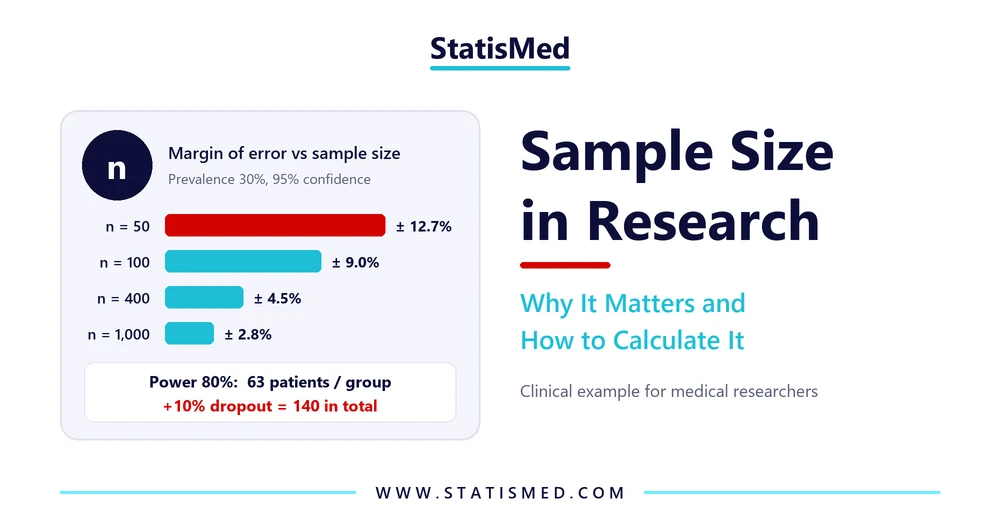
A large sample size in research is important because it reduces the role of chance. With more participants, random variation between individuals averages out, and the sample estimate moves closer to the true value in the population. The table below shows how the margin of error changes with sample size when estimating a prevalence of 30% with 95% confidence:
| Sample size (n) | Margin of error | 95% confidence interval |
|---|---|---|
| 50 | ± 12.7% | 17.3% to 42.7% |
| 100 | ± 9.0% | 21.0% to 39.0% |
| 400 | ± 4.5% | 25.5% to 34.5% |
| 1,000 | ± 2.8% | 27.2% to 32.8% |
Notably, increasing the sample from 50 to 400 reduces the margin of error by almost two-thirds. However, the gain becomes smaller as the sample grows further, because precision improves with the square root of the sample size. For this reason, a larger sample size is better only up to the point where the required precision is reached.
How Does Sample Size Affect Reliability and Validity?
Sample Size and Reliability
Reliability refers to the consistency of results, and it is one of the main reasons behind the importance of sample size in research. A larger sample size increases reliability because repeated studies with large samples produce similar estimates, while repeated studies with small samples produce estimates that vary widely by chance alone. Therefore, a small sample size affects reliability by making the results unstable and difficult to reproduce.
Sample Size and Validity
Validity refers to whether the study measures what it intends to measure and whether the conclusions are correct. A small sample size threatens statistical conclusion validity, since it increases the risk of false-negative results (type II error) and exaggerates the size of effects that do reach significance. However, a large sample does not guarantee validity: a large but biased sample still produces invalid results. Validity also depends on the sampling method, the study design, and the measurement tools.
What Happens When the Sample Size Is Too Small?
An inadequate sample size in research is one of the most common reasons why medical studies are rejected by journals. The main consequences include:
- Low statistical power: real differences between groups are missed, and the study concludes “no difference” incorrectly.
- Wide confidence intervals: the estimates are imprecise and difficult to interpret clinically.
- Exaggerated effect sizes: significant results from small studies tend to overestimate the true effect.
- Poor generalizability: the sample may not represent the population of interest.
- Limited analysis options: subgroup analyses and multivariable models cannot be performed reliably.
Can a Sample Size Be Too Large?
Yes. Although the importance of sample size in research is clear, a very large sample can make small and clinically unimportant differences statistically significant. For example, a difference of 1 mmHg in blood pressure may reach p < 0.05 in a study of 20,000 patients, although it has no clinical value. Therefore, researchers should always interpret the effect size and the confidence interval in addition to the p-value. An oversized study also increases cost and research burden without adding useful information (Andrade, 2020).
How to Calculate Sample Size in Research: A Clinical Example
Consider a hypothetical randomized trial comparing a new antihypertensive drug with a standard drug. The primary outcome is the reduction in systolic blood pressure after 12 weeks.
Step 1: Define the Expected Difference
Based on previous studies, the researchers consider a difference of 5 mmHg between the two groups to be clinically important.
Step 2: Estimate the Standard Deviation
Previous studies reported a standard deviation of about 10 mmHg for the change in systolic blood pressure.
Step 3: Set the Significance Level and Power
The significance level is set at α = 0.05 (two-sided) and the power at 80%.
Step 4: Calculate the Sample Size
For comparing two means, the sample size per group is calculated as follows:
n per group = 2 × (Z1−α/2 + Z1−β)² × SD² ÷ difference²
Using Z = 1.96 for α = 0.05 and Z = 0.84 for 80% power, n = 2 × (1.96 + 0.84)² × 10² ÷ 5² = 62.8, which is rounded up to 63 patients per group.
Step 5: Adjust for Dropouts
Assuming that 10% of patients will not complete follow-up, the final sample size is 63 ÷ 0.90 = 70 patients per group, or 140 patients in total.
The table below shows how the power of the same trial changes with the number of patients per group:
| Patients per group | Statistical power |
|---|---|
| 20 | 35% |
| 30 | 49% |
| 63 | 80% |
| 100 | 94% |
In essence, a trial with only 20 patients per group would miss a true 5 mmHg difference in about two out of three cases. The same logic applies to other designs, such as comparing proportions with the chi-square test, although the formula differs. You can read more in our guide on understanding sample size in research.
How to Report Sample Size in a Manuscript
Because of the importance of sample size in research, journals and reporting guidelines, such as CONSORT for clinical trials, require a clear description of how the sample size was determined. An example of a sample size statement in the Methods section is shown below:
Sample Size Calculation
The sample size was calculated to detect a difference of 5 mmHg in systolic blood pressure reduction between the two groups, assuming a standard deviation of 10 mmHg, a two-sided significance level of 0.05, and a power of 80%. A total of 63 patients per group was required. Allowing for a 10% dropout rate, 70 patients per group (140 in total) were recruited.
Conclusion
The importance of sample size in research comes from its central role: it determines whether a study can detect real effects, estimate them precisely, and generalize the findings to the population. A sample that is too small leads to low power, wide confidence intervals, and unreliable conclusions, whereas a sample that is too large wastes resources and may highlight clinically trivial differences. Therefore, the sample size should be calculated before data collection, based on the expected effect, the variability of the outcome, the significance level, and the desired power. If you need help with sample size calculation for your protocol or grant application, the StatisMed team of biostatisticians can support you. You can request a free quote today.
Frequently Asked Questions
1. What is a good sample size for a research study?
There is no single number that suits all studies. The appropriate sample size depends on the study design, the primary outcome, the expected effect size, the variability of the data, the significance level, and the desired power. It should always be calculated rather than chosen arbitrarily.
2. Why is a larger sample size better in research?
A larger sample size increases statistical power, narrows confidence intervals, and improves the reliability and generalizability of the results. However, the benefit decreases once the required precision is reached, and very large samples may make clinically unimportant differences statistically significant.
3. How does a small sample size affect a study?
A small sample size reduces statistical power, increases the risk of false-negative results, produces wide confidence intervals, and may exaggerate the size of significant effects. As a result, the findings become less reliable and harder to reproduce.
References
Andrade, C. (2020). Sample size and its importance in research. Indian Journal of Psychological Medicine, 42(1), 102–103. https://doi.org/10.4103/IJPSYM.IJPSYM_504_19
Faber, J., & Fonseca, L. M. (2014). How sample size influences research outcomes. Dental Press Journal of Orthodontics, 19(4), 27–29. https://doi.org/10.1590/2176-9451.19.4.027-029.ebo